
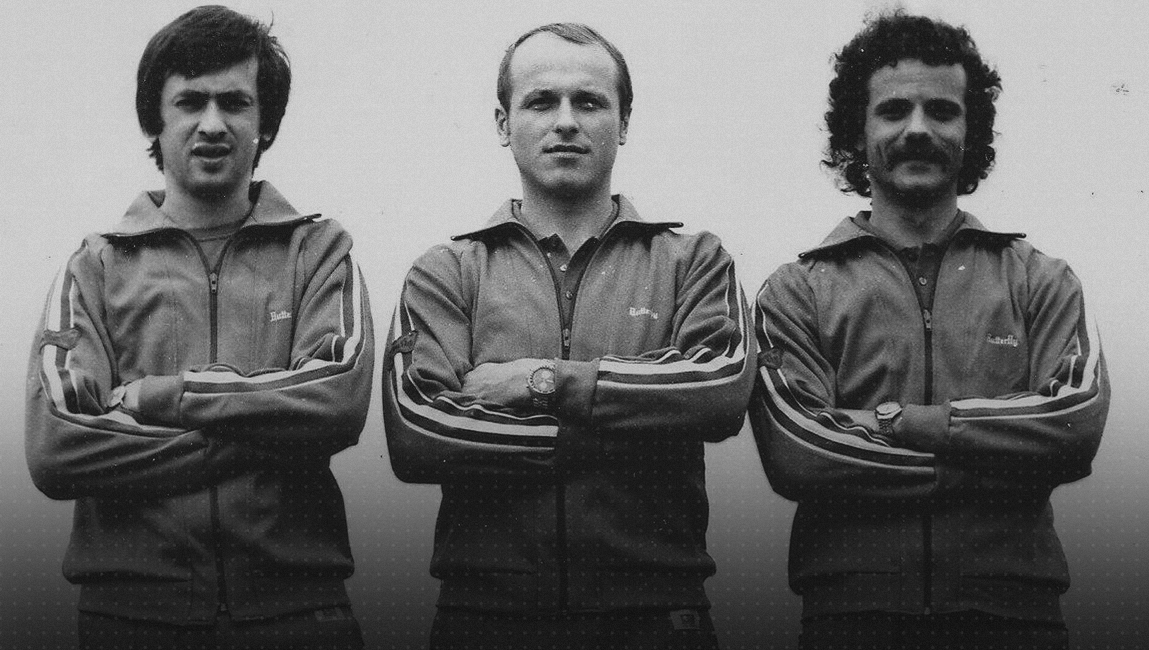
30 April, 1979. Pyongyang, North Korea. The Hungarian national team repeats the success of their predecessors and becomes the world champions in team event, after confidently beating the Chinese team in the final 5-1. The heroes of this golden run were three table tennis greats – Istvan Jonyer, Tibor Klampar, and Gabor Gergely. It took 27 years for Hungarians to bring the Swaythling Cup trophy home, as their last gold in the team event was won at the 1952 World Championships in Mumbai. How did Hungarians manage to achieve this success? Let’s explore the story of this legendary trio and find the answers.
The 1970s era in table tennis was mostly dominated by Chinese, Japanese, Swedish, and Hungarian players. The previous gold medals in team events during this decade were won once by the Swedes and three times by the Chinese team. Individually, Stellan Bengtsson was able to break the Chinese and Japanese hegemony in 1971, winning the singles title. Four years later, Istvan Jonyer did the same in Kolkatta. While most of the medals at the World Championships were still won by the Chinese and Japanese players, the gap between them and European players was not as big as nowadays.
Hungarians were one of the pillars of table tennis development in its early days. Up to this day, Hungary is the second most successful nation in World Championships history. Only Chinese players have won more medals. The success of Viktor Barna, who was almost unbeatable in the early 30s, inspired the next generations of world-class players from Hungary. They had a high standard to meet. Table tennis became more popular and competition was tougher in the next decades. Czechoslovak and English players made great improvements and took the leading positions at the World Championships. Hungarians remained among the favorites and had some really good runs. Ferenc Sido was their leading player during the 50s. He won the singles title in 1953, becoming the last European to win it, until Bengtsson’s triumph in 1971.
In the mid-50s, another table tennis star emerged in Hungary. His name was Zoltan Berzcik. He could not reach the gold at the World Championships, but he dominated the first two European Championships editions. Early in his career, Berczik fought alongside Sido and late in his career, he faced the 1979 heroes.

This success was no coincidence. Hungarians had strong traditions in table tennis and former greats, who could share their experience with the young generation. They knew how to become world-class players. Sido and Berczik were involved in coaching the national team and luckily, they got three different, and very talented players in their hands. Coaches understood the potential Jonyer, Klampar, and Gergely had. Berczik, who was known for having a phenomenal work ethic as a player, kept the same mentality as a coach. Long hours of practice and heavy physical training were his recipe for success. It did not always suit his players 100%, but the results were there. The gold medals Hungarians won at the World and European championships were proof that Berczik’s system works.
Of course, it wasn’t always going smoothly. Many players and coaches later agreed on the thought that Hungarians missed out on at least one more World Championships gold in the team event. There were some issues that messed up a few major tournaments for the Hungarian team. First, it was the injuries. Istvan Jonyer was a very athletic player, built like a tank, with massive legs. He was a very hard-working player, but the weight training forced Jonyer to miss tournaments due to meniscus injuries. It also had an impact on his longevity. But the main issue that caused Hungarians the majority of problems was the behavior of Tibor Klampar. A player ahead of his time, and very talented, but he had a problem controlling his temper. The Hungarian table tennis association banned Klampar several times for various misconducts.
The characters of Berczik and Klampar were hardly comparable. The coach was all about discipline and tough love, while Klampar sometimes needed a less strict approach. Both clashed heads often and we must remember that Hungary was a Communist state at the time. The athletes from the Eastern Bloc were generally living under stricter rules than their Western counterparts. Disciplinary issues were punished harder in countries, like Hungary. The one who could get along better with Klampar was Sido. He was coaching the talented Hungarian star at the Budapest Spartacus club.
The situation before the 1979 World Championships was also on the brink of disaster. Klampar was removed from the training camp before the tournament after another clash with Berczik and Hungarians were about to go to Pyongyang without him. Understanding that it might be their last chance to win the gold in the team event, Jonyer and Gergely tried to convince the coach and high-ranked sports officials to allow Klampar to rejoin the team. They let everyone know that without Klampar, it won’t be possible to win the gold. Luckily, the officials weren’t so stubborn at this time and the Hungarian team traveled to North Korea with all the best players in the squad.

The success of Hungarians in Pyongyang was no coincidence or luck. They had everything to challenge the Chinese team. All three of their leading players were at the peak of their power. 26-year-old Gabor Gergely was the reigning European champion, winning the title a year earlier in Duisburg. In that European Championships final, he faced his teammate, Istvan Jonyer. Hungarians knew the pressure that awaits them in pursuit of a gold medal. But they already were World and European champions. The experience was there. They weren’t some underdogs. In Pyongyang, Hungarians were the ones to be respected and feared.
In the group stage, they cruised past all their opponents, including Yugoslavs, French, North Koreans, and the eventual finalists – the Chinese team. In the semi-final, Hungarians faced the Japanese team, led by the eventual singles event winner Seiji Ono. He was able to win one game against Gergely, but his teammates could not get a single win and Hungarians confidently advanced to the final after a 5-1 win.
The final was played on Klampar’s birthday, and of course, Hungarians were eager to celebrate this day for two great occasions. After the success in the group stage, the confidence was there. Gergely set the tone of the game early. He left no chance to Guo Yuehua, confidently winning the opener 2-0. His teammates followed the example. Jonyer showed why he is a 3-time World champion and brought a solid 2-0 win against Lu Qiwei. The Chinese team needed a win to hope for a comeback. But Tibor Klampar was in great form. In a similar fashion as his teammates, Klampar won 2-0 and the overall score was already 3-0. The situation was turning more hopeless for the reigning World champions.
As the fourth match-up went on, the Chinese finally showed some serious resistance. Guo Yuehua lost the first set to Jonyer, but he was able to win the next two. Narrowly, but he got the first win for the Chinese team. His teammates also performed better, each winning the first set of their next game. Still, it wasn’t enough. Hungarians were simply too strong that day. Gergely made a comeback against Li Zhenshi and Klampar said the last word against Lu Qiwei, completing the dream run. It became the peak moment of Hungarian table tennis. The one to remember for the next generations.
After this success, Hungarians kept themselves among the favorites for the major tournaments. Two years later, they once again reached the final of the team event, and played against the Chinese time that was strongly motivated to take revenge. This time, Hungarians had a tough time. Jonyer and Klampar, each won a game, but it wasn’t enough to hope for the gold medal again. Chinese team took a solid 5-2 win and reclaimed their table tennis crown. In 1983, a year after winning the European Championships, Hungarians enjoyed their last great run at the World Championships. Even without Klampar, they were able to win the bronze medals.
With this run, the careers of the Hungarian legends began to fade. Jonyer and Gergely focused on their club careers and Klampar remained the only one, to still be present in the international arena. The last medal Hungarians managed to win at the major tournaments – was the bronze in the team event of the 1988 European Championships. After that, the golden times for Hungarian table tennis were about to end.
Don’t miss out the news from Table Tennis Media, subscribing to our free newsletter and explore the premium content on our Patreon.
 Table Tennis Media