
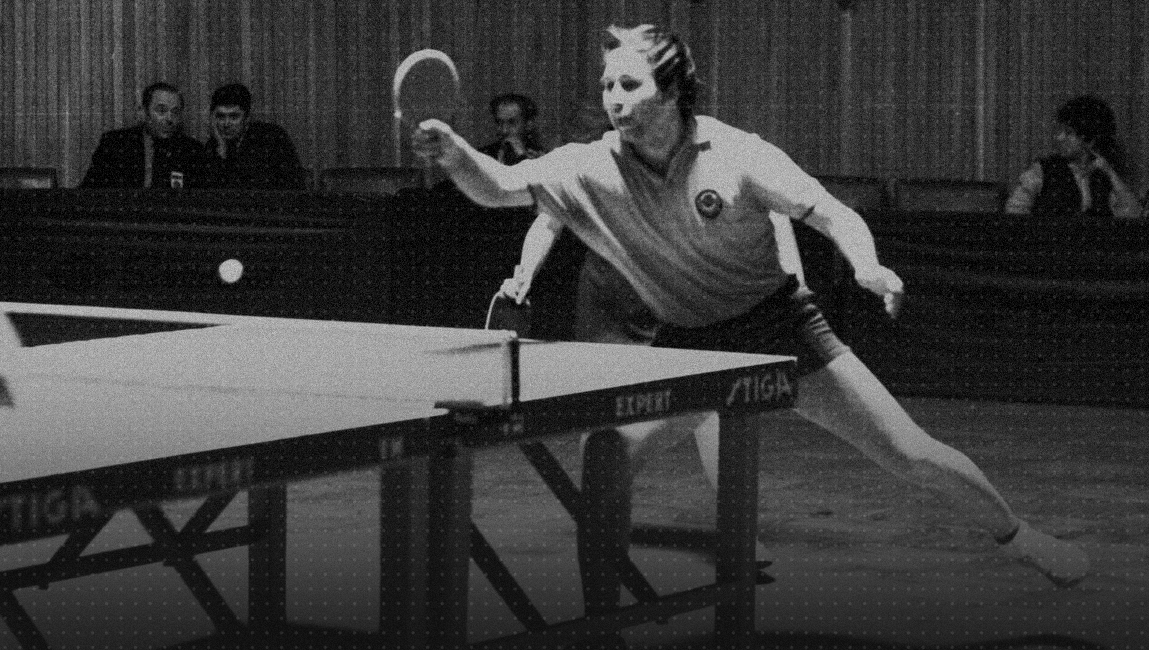
As with every sport, table tennis has seen the evolution of its athletes throughout the years. Eventually, it was polished into this concept of modern table tennis – a highly athletic and technical sport. Every element of table tennis had an athlete who at one point, gave a foundation for the development of a modern-day forehand loop, modern-day service and so on.
The Soviet international Stanislav Gomozkov was the father of the modern backhand. One of the leading European players of the 60s and 70s era, Gomozkov had the finest backhand in the World in his prime. He had a quick, sharp backhand stroke that earned him a lot of points.
Born in 1948, the future World and European champion got his first major accolade in 1965, winning the Soviet National Championships. In the final, Gomozkov was a clear underdog, playing against the more experienced Soviet international, Zigmunds Kalniņš. The outcome surprised many, and this title was the first step into more than a decade of a World-class career.
Up until 1977, Gomozkov was consistently a Top 20 player, reaching as high as 5th place in the World Rankings in 1967. For a decade, he was listed among the favorites of every major tournament in table tennis, often getting wins against some of the best players in the World. In doubles, Gomozkov was even better, eventually becoming one of the best doubles players of all time.
And it is no exaggeration. Together with Anatoly Amelin, Gomozkov won the silver at the 1967 World Championships, and a bronze medal at the 1969 World Championships. In 1975, he became a World champion in the mixed doubles event. Up until the fall of the Soviet Union, Gomozkov remained the only Soviet player to win a gold medal at the World Championships.
He also achieved an impressive record at the European Championships that still remains unbeaten. From 1968 to 1974, Gomozkov won four consecutive gold medals in the mixed doubles event. Together with Zoja Rudnova, they completely dominated this event. It’s a record that is very unlikely to be broken in the foreseeable future.
Although Gomozkov had a solid forehand, the backhand was his trademark throughout all of his career. It was a solid prototype of the modern version. Not that polished yet, but already a great example to present it to the young players, as something to study and emulate. The Hungarian legend Tibor Klampar took the torch in the 70s and polished the backhand technique into an even more fast and efficient version. His backhand was later studied by such all-time greats, as Jan-Ove Waldner.
Eventually, the backhand and other table tennis elements did evolve to the modern standard. But table tennis fans shouldn’t underestimate the impact of players, like Gomozkov. The highlights from the 60s and 70s era are limited, and those might not look that impressive from the modern-day perspective. However, at the time young players were taking notes. Information was much more limited, and every chance to see a World-class athlete playing was very valuable.
Gomozkov’s playing style was quite uncomfortable for many of the leading players at the time. He had some memorable wins against Swedish table tennis legends. For example, at the 1973 World Championships in Sarajevo, Gomozkov eliminated the reigning World champion and World Ranking leader, Stellan Bengtsson. But this was just one of many impressive wins of his career.
Gomozkov peaked early and retired relatively young, at the age of 30. However, it was more of a forced retirement, since the Soviet team was keen to give a chance for the new generation of players. He got offered a coaching role instead. In the modern-day environment, he probably could’ve played for 5-6 years more, but the Soviet sports system was strict. If the management decides to retire someone, there is nothing an athlete can do.
The athletes from the Soviet Union did not have freedom, like their Western counterparts. They could participate in international tournaments only as long as they were members of the national team. Playing for the clubs, and earning money somewhere abroad was impossible to do.
Nevertheless, Stanislav Gomozkov retired as the greatest Soviet player ever. World-class career, numerous accolades, and some records that will never be broken. He impacted the evolution of table tennis and had a career worthy of remembering.
Don’t miss out the news from Table Tennis Media, subscribing to our free newsletter and explore the premium content on our Patreon.
 Table Tennis Media